
Central to every major city are its cultural cornerstones. Iconography such as food, entertainment, and sports become part of the city and its people, especially in large metropolitans like Chicago.
“These teams represent a good bit of the identity of the residents of the city they happen to be in, DePaul Professor and long-time sports journalist Fred Mitchell said. “Whether they’re rich, high-income, middle-income, or low-income, everyone takes a certain pride associating themselves with these professional teams.”
Professional sports as a cultural institution have exponentially grown in value over the last several years. Particularly for the United States’ two biggest leagues – the NFL and NBA – franchise value has exploded. From 2001 to 2002, the average value of a franchise ballooned from millions to multiple billions of dollars, with the starkest growth occurring in the last several years.
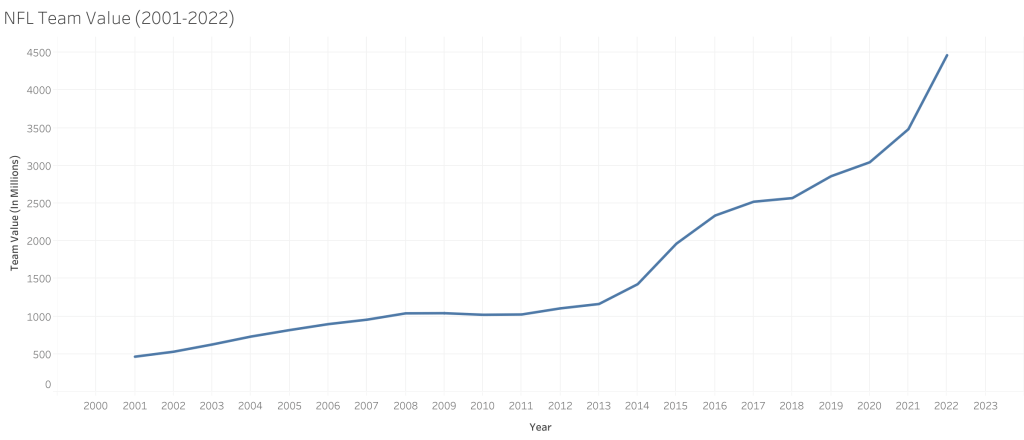
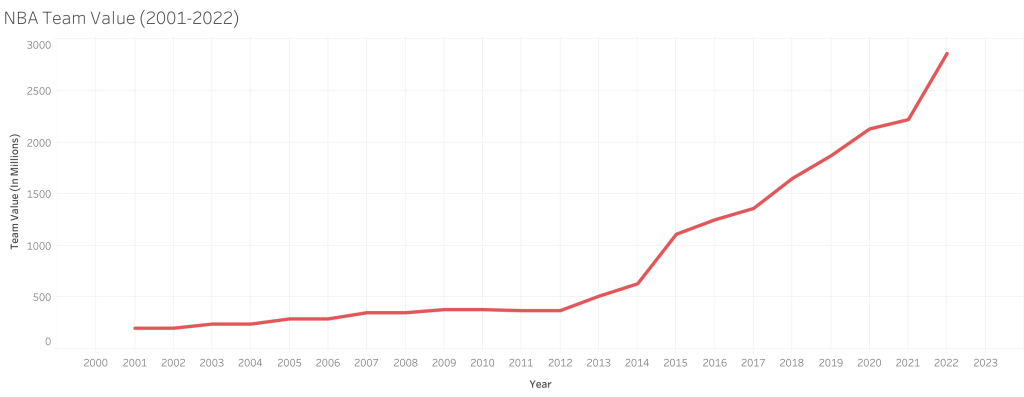
Such astronomical value makes professional sports franchises some of the most interesting cases studies of corporate social responsibility (CSR). According to Forbes, SCR was described by University of Georgia professor Archie B. Carroll in the form of a pyramid that argued companies had four key obligations: profitability, legality, ethics, and philanthropy.
Unsurprisingly, Carroll’s model did not weigh all these responsibilities equally. Economic sustainability came first and foremost, residing at the base of the pyramid.
“Most corporations, their first responsibility is to their shareholders,”DePaul School of Public Service assistant professor Danielle Vance-McMullen said. “So, usually when there’s not a sole proprietorship, companies have to show that the philanthropy they’re doing is good for their bottom line.
Sports franchises are in a unique position being so intrinsically tied to the culture of cities in which they reside. Particularly in the largest U.S. metropolitans like New York, Los Angeles, and here in Chicago, those hugely valuable business hold a deeper meaning to the community than most.
“Organizations like sports franchises that are so integral to the fabric of a community and a community’s identity, they hold a lot of power,” DePaul professor of sports communication and journalism Vincent Peña said.
Although corporate donations often (intentionally) receive extensive coverage, they do not make up a significant portion of total philanthropic contributions. Per Giving USA (2021), roughly 4% of the $471 billion in total giving in the United States ($16.9 billion) comes from corporate foundations.
However, where the charity arms of professional sports teams begin to differ (including in Chicago) is that teams actively identify with team-affiliated charitable foundations ostensibly tailored towards addressing issues within their communities. Between the Cubs’ Diamond Project, White Sox Volunteer Program, Chicago Bulls Charities, Bears Care, etc. Chicago’s biggest teams have longstanding organizations in place meant to support education, volunteer work, and medical research, amongst other causes.
Whereas private foundations largely donate directly from the corporate entity itself, public charities can solicit support from individuals and other companies. Between the Cubs’ Diamond Project, Chicago Bulls Charities, Bears Care, Chicago Blackhawks foundation and many others, Chicago’s pro sports teams have a multitude of avenues to receive donations and give back, ideally reciprocating the support fans give them in spades.
“Both of [the Blackhawks’] facilities are located on the west side of Chicago, and a lot of impoverished and low-income residents are around those facilities,” Mitchell said. “Rocky Wirtz, the Blackhawks’ owner, felt the need to improve the community in which they reside with educational programs, free skating, and other opportunities. That’s served as a great model for teams in Chicago.”
Both independently and collectively, Chicago’s professional teams have been able to provide service to their communities. In the recent midterms, the United Center (home of both the Bulls and Blackhawks) was used as a polling place, while Bears fans were able to bring mail-in ballots to a November 6th game at Soldier Field, where two ballot boxes were available.
Perhaps most notably (and timely), the Bears, Blackhawks, Bulls, Cubs, and White Sox have been communally involved with the McCormick Foundation – a Chicago-based non-profit formed in 1955. Since 2017, the Chicago Sports Alliance has been able to invest $4 million in grants towards the Chicago Crime Lab (with another $1.5 million from the McCormick foundation) with the goal of researching data-driven solutions for reducing gun violence in Chicago – especially prevalent after 797 gun-related homicides in 2021 represented the highest mark in a quarter century.
In a CSR context, these efforts can be taken different ways. As written in Professor Kathy Babiak and Dr. Daniel Yang’s 2022 research article “Team Ownership and Philanthropy in Professional Sport: A Perspective on Organizational Generosity,” corporate philanthropy can be viewed as an effort towards serving the common good, or an investment into the community in which a firm operates. Given the reliance a sports team has on the community it resides in (tickets sales, merchandising, facility management) it becomes more evident why it is so important that teams reciprocate fan support.
“Given the importance of these [teams] to their communities, I think the impetus is on them to give back more,” Peña said.
Even in smaller, subtle ways, teams are capable of being socially conscious of their communities. As an potential precedent, Falcons owner Arthur Blank started selling concessions for $4 with the understanding that fans are already often paying out the nose to attend games, so helping them lighten costs at games encourages support and is reciprocates it financially.
“Just taking less out of the pockets of the fans that are already spending their money… instead of taking advantage of them, helping them out in that way, it’s great,” Peña said.
Ultimately, allocating resources towards causes that directly benefit the health and safety of Chicago is an encouraging show of support, regardless of context. To try and moralistically juxtapose the contributions of Chicago’s professional sports franchises can quickly become a discussion that ignores the value teams do provide to the community.
Social issues are not decreasing in prominence – particularly but continuing to be socially conscious franchises give Chicago teams a chance to contribute to solutions.
“You can say they’re pillars of the community,” Peña said. “The importance that they serve, whether or not the choose to donate to certain causes can communicate a message, they have a lot of power in where they choose to spend their money.”
In the spirit of the story above, but if you also are looking to contribute to the health of Chicago, homelessness and housing insecurity leaves hundreds of Chicagoans out in the cold, and winters are only getting harshers. If you can spare it, consider donating to the many shelters available in the city. The map below gives a convenient breakdown of where many are located. Stay safe, and happy holidays!

 Zach E. Portfolio